WWPD
WWPD
WWPD
WWPD
WWPD
WWPD
WWPD
WWPD
WWPD

Tuesday, March 24, 2015

Ancients: More Thoughts on Flanking

I have been thinking more about how to represent threats to the flanks, or overwhelming, of Units in shorter battlegrounds.  The basic situation I wish to address is the following:


Obviously in this situation, E is overwhelmed by numbers, if nothing else, and should suffer some sort of penalty fighting A + B + C.

The question is how to achieve this through the game-mechanics.  WFB, for example, has an elaborate system of turn radii and angles that would allow A and C to either multicharge on E, or to flank charge either side (for a whopping penalty).  Hail Caesar would say A and C are supporting B, and give B a combat bonus of some sort.

I hate worrying about clipping and charge angles, though.  The WFB solution is out.

I have considered a system similar to Hail Caesar, where either A would get a bonus or E would receive a penalty, either to combat or to morale. 

This is trickier than it looks, because we must consider the relative capacities of all Units involved. Let us imagine E is a huge, elite regular unit, and A B and C are puny.  Hail Cesar! scales the bonus A gets based on the close-range capacity of A and C.  I would have to add another element (support dice) to my system to do the same.  A workable possibility.

I'm thinking I want to be different however ...

A potential solution?

Under my system all charges from before a 180 degree line of a Unit's front would charge to the front.  A would charge B's front and, if it reached B, adjust to the center. Being front to front and base to base would be considered an abstraction, representing a melee that might actually be more fluid.


Now, if multiple units were involved, the charge would try to bring them all in, centering the whole charging line on the target unit.


Corner units A and C would be able to attack with their full dice, regardless of whether the relative unit sizes were as above or more like this ...


This would heavily penalize E, even in the absence of special rules about threatened flanks.  (Maybe even too much so.)  E would be highly encouraged to bring some buddies:


 For a more even fight.

It might also be advisable to allow new units to enter and adjust the spacing of combat..

With this


shifting the combat to become this...


 Any thoughts out there?

Wednesday, February 18, 2015

Ancients: Shooting

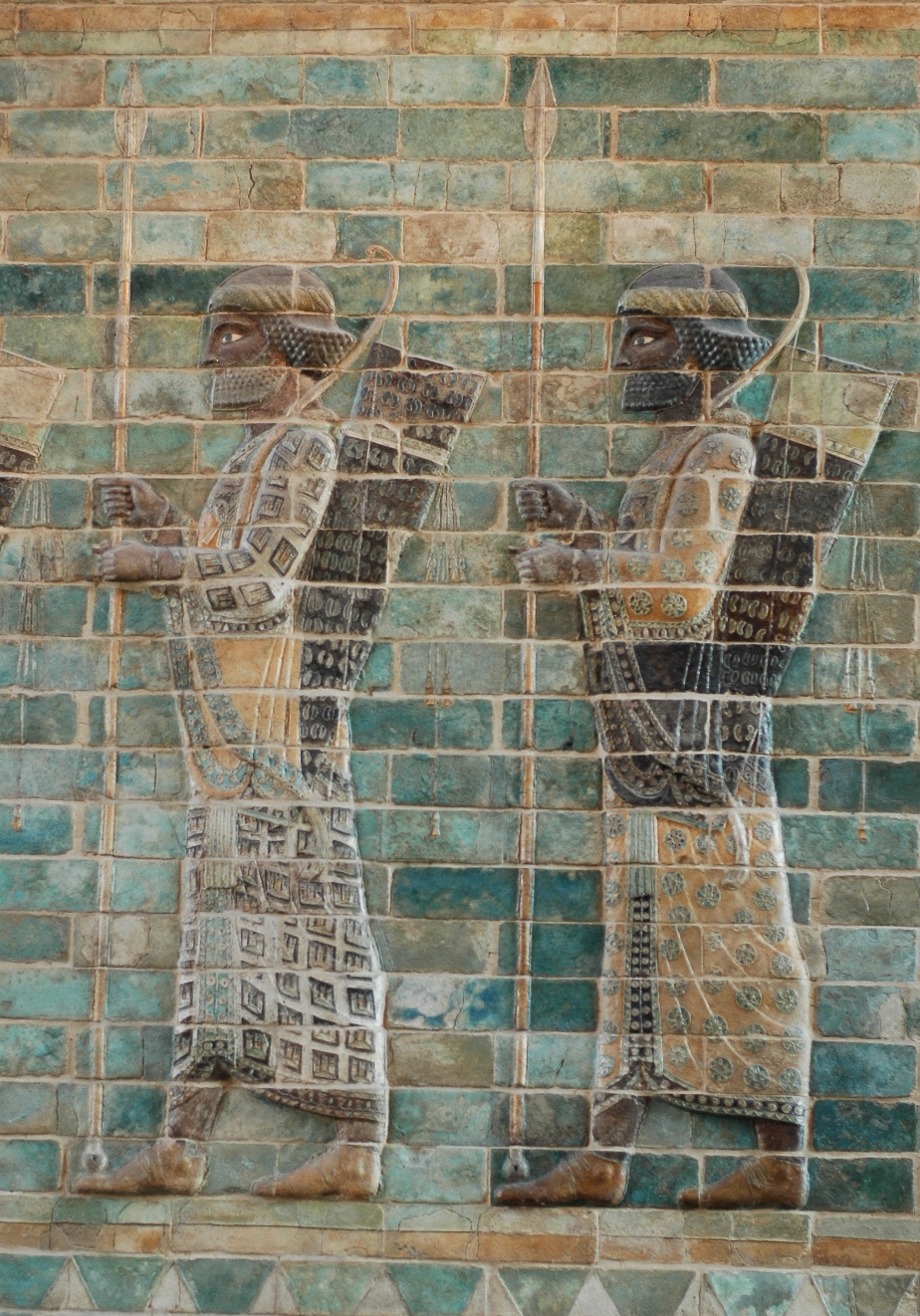
Persian archers. Wikimedia.
"This then is how the Lacedaemonians and Thespians conducted themselves, but the Spartan Dieneces is said to have exhibited the greatest courage of all. They say that he made the following speech before they joined battle with the Medes: he had learned from a Trachinian that there were so many of the barbarians that when they shot their missiles, the sun was hidden by the multitude of their arrows. He was not at all disturbed by this and made light of the multitude of the Medes, saying that their Trachinian foreigner brought them good news. If the Medes hid the sun, they could fight them in the shade instead of in the sun. This saying and others like it, they claim, Dieneces the Lacedaemonian left behind as a memorial."

--- Herodotus 7.226

Shooting will follow rules very similar to melee combat, but with certain modifications. Shooting is less likely to be effective in completely breaking a unit, and the odds of hitting a target will depend variously upon the skill of the shooter and the formation of the defender. 

Ranged Weapons

A unit's ranged attacks will be rated by the unit's Size, the weapon's lethality, and its range.

The number of dice rolled reflects not only the rate of fire of the weapon, but also the training and doctrine of the unit.


Slings/Javelins
Bows
Superior Bows
Huge
10
12
14
Large
8
10
12
Medium
6
8
10
Small
4
6
8

Range:
  • Slings/Javelins 12"
  • Bows 24"
  • Superior Bows 24"
To-Hit

When shooting at most targets, the difficulty is based on the skill of the firing unit.

Skill 1 5+
Skill 2 4+
Skill => 3 3+

When shooting at Skimishers, however, the to-Hit threshold is based on the relative skills of both units.

  • Attacker's Skill < Defender's Skill:  5+
  • Attacker's Skill = Defender's Skill: 4+
  • Attacker's Skill > Defender's Skill: 3+

This is because we are assuming that Formed or Warband Units defend themselves with their armor, but will not break their formation in order to disperse or use the sweep of the land to defend themselves. Skirmish units, however, will use their full skill and cunning to sneak around.

The to-Hit roll is further modified by the following, potentially cumulative, factors:
  • Target is over 12" away: +1 to difficulty.
  • Target is in area terrain or behind linear terrain: +1 to difficulty.

Saves and Break Tests


Units Save in shooting following the same rules as melee combat.

Units add up the Hits they have taken at the end of the shooting phase.  If this equals or exceeds their Hit Threshold, they must make a Break Test, with the same modifiers, etc, as in the melee phase.

When they make their test, however, they are less likely to break from shooting, and are more likely to fall back.  A unit that exactly equals the number needed for its break test, or fails it by 1, Gives Ground rather than Breaks.


Monday, February 2, 2015

Ancients: A Basic Combat Mechanic


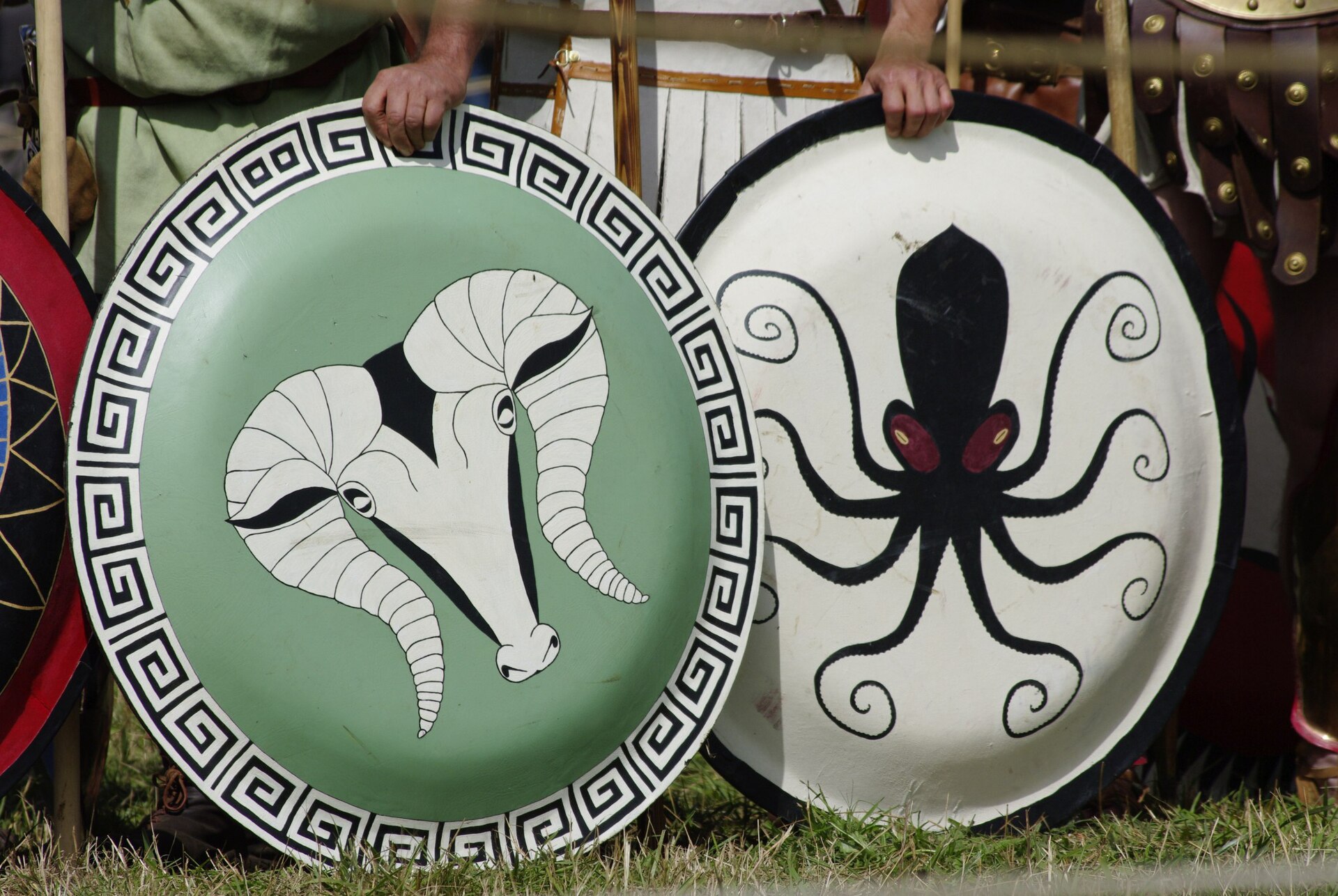
Greek Shields.  Wikimedia.
Some say an army of horsemen, or infantry,
A fleet of ships is the fairest thing
On the face of the black earth, but I say
It's what one loves.
This is very easily understandable to do
For each of us. She who far surpassed
The beauty of all, Helen, just went and left
Her noble husband
Sailing she went far away to Troy,
And thought nothing of child or parents dear,
Nothing at all, but ...................led her off,
............ing.
.........................bent.......
............................and lightly.........
...reminds me of Anactoria who is not here
Whose lovely way of walking, and the dark flash
Of her face I would rather see ---- than
War-chariots of Lydians and spear-men struggling
On a dusty battlefield.

        Translated by William Harris

Basic Combat Mechanics

Here is a sketch of the combat mechanics for my proposed Ancients game.  My goal is for a simple system, that focuses more on the training and organization of the combatants than the nuances of their equipment.

Number of Dice

The number of dice a unit rolls in combat is determined by its size. The number of dice are not affected by casualties the unit has suffered, nor is it affected by where on the facing the combat occurs or how many models are in base to base. (These factors will be accounted for elsewhere.) If a unit is fighting more than one opponent, it may split its dice however it wants.

  1. Huge 12
  2. Large 10
  3. Medium 8
  4. Small 6

Some units may be designated Shock or Defensive.  A Shock Unit generates extra dice on the first turn of a new Combat, if it Charged or Counter-Charged.. A Defensive Unit generates extra dice on the first turn of a new Combat, if it has not Charged.   Total dice in these situations:

  • Huge 14
  • Large 12
  • Medium 10
  • Small 8

To-Hit

Each opposing Unit rolls its dice simultaneously.  If the Units are evenly matched, the number needed to-Hit is a 4+ . In most combats, however, one Unit will have an Advantage over the other.  In each of the following categories, a Unit may gain Advantage.  Count how many steps better than the other Unit it is. 

Skill
Higher Skill  > Lower Skill  (The difference in skill levels is the total Advantage)

Weight Class
Heavy > Medium > Light

Unit Type
Cavalry > Infantry

Formation
Formed > Warband > Skirmish

Position
Engaging Enemy in Rear > Engaging Enemy in Flank > Engaging Enemy in Front

If the Units each generate Advantage, from different categories, then Advantages cancel each other out.

Advantage modifies the to-Hit rolls.

If neither Unit has Advantage, they both hit on a 4+.

If a Unit has one net point of Advantage, the Unit with Advantage hits on a 3+.  The Disadvantaged Unit his on a 4+.

If a Unit has two or more net points of Advantage, the Unit with Advantage hits on a 3+ AND the Disadvantaged Unit his on a 5+

Saves

Units then make saves based on their Weight class.

  • Heavy 4+
  • Medium 5+
  • Light 6+

Resolution

Each Unit has a number of Hit Threshold based on its Size:

  • Huge 5
  • Large 4
  • Medium 3
  • Small 2

If a Unit takes a number of Hits equal to this threshold, it must take a Break Test at the end of melee.  A Break Test is a Leadership Test modified by the following:

  • +1 If the Unit has not yet made any Break Tests this game.
  • +1 If the Unit was on the winning side of the combat, based on the number of total Hits each side took.
  • -1 For each additional full multiple of of its Hit Threshold taken.
  • -1 For each Damage Token on the Unit from Previous Combats.
If the Unit fails the Break Test, it is destroyed.
If the Unit exactly equals the score needed, it Gives Ground. 
If the Unit exceeds the score needed to pass, it is unaffected.

After the test is made, any surviving units receive a permanent Damage Token.  If they were Hit for multiple Hit Thresholds, they receive multiple Damage Tokens equal to the number of full multiples of the Threshold.

Follow-Up Moves

If a Unit Gives Ground, move it backwards half its Movement Rate.  If its opponent(s) are not also Giving Ground, or locked in a continuing Combat, they may elect to move forward by half its Movement Rate.  If this keeps it in contact with the Unit Giving Ground, they remain in combat.
If both opponents Give Ground, they move away from each other.

For the Math Geeks

In case you are wondering, here are the average number of Hits for different unit Sizes by dice thrown (chart),  by dice score needed (vertical) and armor save (horizontal). For the most part a Unit's Hit Threshold is just a bit less than the number of Hits a Medium Weight Unit will typical receive from an opponent of equal Size and Skill.


14 - 6+ 5+ 4+ 3+ 2+
6+ 2.333333 1.944444 1.555556 1.166667 0.777778 0.388889
5+ 4.666667 3.888889 3.111111 2.333333 1.555556 0.777778
4+ 7 5.833333 4.666667 3.5 2.333333 1.166667
3+ 9.333333 7.777778 6.222222 4.666667 3.111111 1.555556
2+ 11.66667 9.722222 7.777778 5.833333 3.888889 1.944444


12 - 6+ 5+ 4+ 3+ 2+
6+ 2 1.666667 1.333333 1 0.666667 0.333333
5+ 4 3.333333 2.666667 2 1.333333 0.666667
4+ 6 5 4 3 2 1
3+ 8 6.666667 5.333333 4 2.666667 1.333333
2+ 10 8.333333 6.666667 5 3.333333 1.666667


10 - 6+ 5+ 4+ 3+ 2+
6+ 1.666667 1.388889 1.111111 0.833333 0.555556 0.277778
5+ 3.333333 2.777778 2.222222 1.666667 1.111111 0.555556
4+ 5 4.166667 3.333333 2.5 1.666667 0.833333
3+ 6.666667 5.555556 4.444444 3.333333 2.222222 1.111111
2+ 8.333333 6.944444 5.555556 4.166667 2.777778 1.388889


8 - 6+ 5+ 4+ 3+ 2+
6+ 1.333333 1.111111 0.888889 0.666667 0.444444 0.222222
5+ 2.666667 2.222222 1.777778 1.333333 0.888889 0.444444
4+ 4 3.333333 2.666667 2 1.333333 0.666667
3+ 5.333333 4.444444 3.555556 2.666667 1.777778 0.888889
2+ 6.666667 5.555556 4.444444 3.333333 2.222222 1.111111


6 - 6+ 5+ 4+ 3+ 2+
6+ 1 0.833333 0.666667 0.5 0.333333 0.166667
5+ 2 1.666667 1.333333 1 0.666667 0.333333
4+ 3 2.5 2 1.5 1 0.5
3+ 4 3.333333 2.666667 2 1.333333 0.666667
2+ 5 4.166667 3.333333 2.5 1.666667 0.833333

Wednesday, January 14, 2015

Ancients: Unit Types

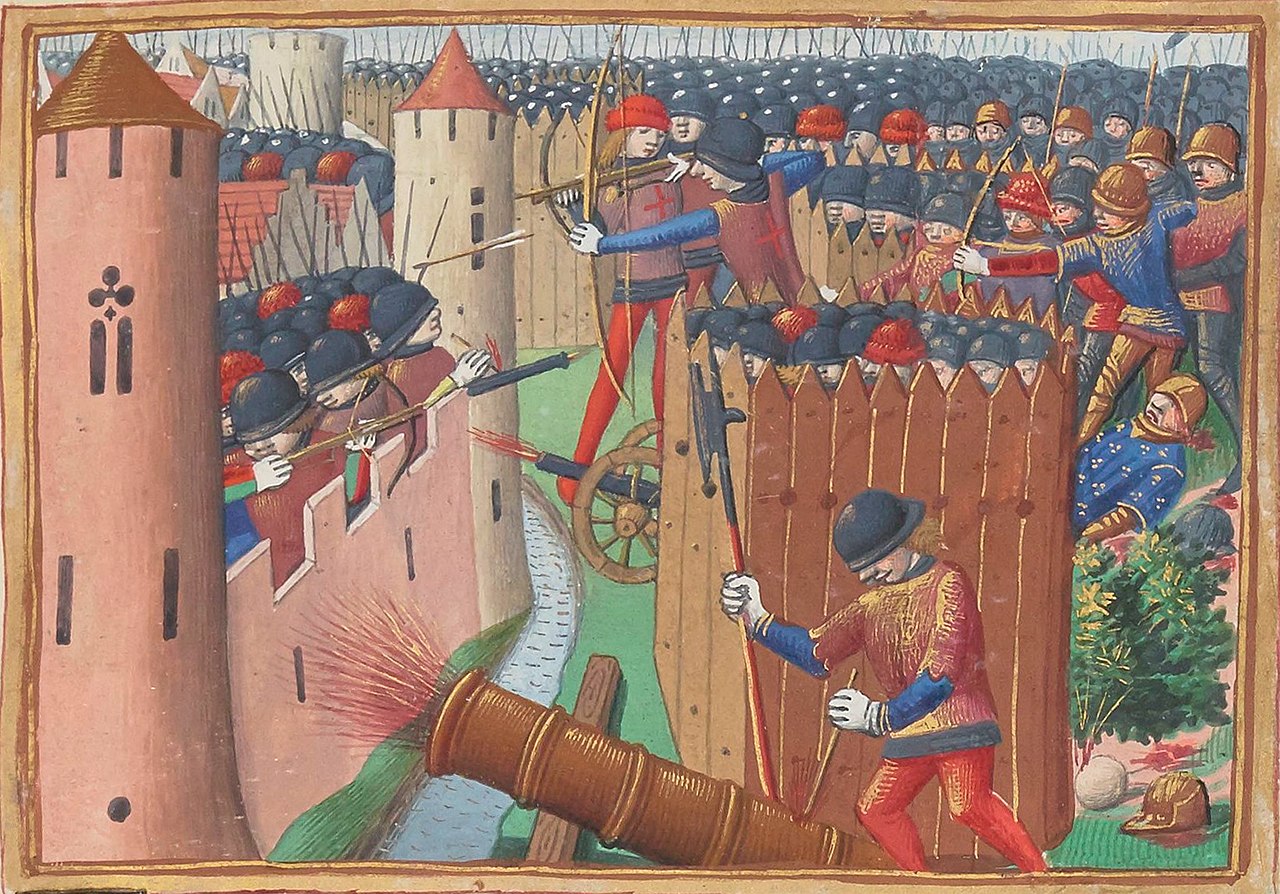
Siege of Orleans.  Wikipedia.
In this post, I continue designing a simple Ancients wargame.  My next major design decision is in how to mathematicaly describe and represent different units of varying type and quantity.

General Principles

The smallest game-mechanical representation will be the unit, not the model. Units together will have hit points, attacks, skill and leadership defined collectively.  Individual models will not be counted or removed during play, only the frontage and dimensions of the unit will matter for purposes of play.  

Hail Caesar! handles units this way, and I'm shamelessly imitating them.  After years and years of WFB, I'm totally and completely sick of removing models from unit trays.

Each Unit will be described by combining the following factors:

Size

Units can be of varying Size.  Let's call them Small, Medium, Large and Huge.  Small Units will be approximately 6" wide on the front.  If players are using 28mm models on a 1" base, this makes a frontage of 6 models.   Medium Units will be approximately 8" wide (around 8 models).  Large Units will be approximately 10" wide (around 10 models)  Huge Units will be approximately 12" wide (around 12 models).

Depth is less important than frontage:  Units should be at least 2 infantry or 1 cavalry models deep; 3 or 4 will look better on the table. 

Size will dictate the number of Attacks and Hit Points a unit possess.

Type

Units will be defined by their Type.  The basic Types are Infantry and Cavalry, but there may be other Types, like Warmachine or Elephant (or Airplane or Flying Carpet or whatever.)

Type will dictate Movement rate, and may apply other special rules.  It will also help dictate who has the Advantage in melee.

Weight  

Weight indicates the relative level of armor and equipment the Unit carries.  Weight can be Light, Medium or Heavy.  Weight will dictate the Save value of a Unit.  It will also help dictate who has the Advantage in melee.

I am more interested in defining a Unit's equipment by weight than by the specifics of armament, such as whether spears are superior to swords, or halberds to billhooks.  Weight is also relative to the period.  Hoplites, for example, are clearly Heavy in the Classic Period, but by the Hundred Years War, they might be only Medium compared to a Foot Knight.

Formation

Formation indicates the way the Unit fights and behaves on the battlefield, and the density and coordination of the unit.

Formed Units fight in close support of each other in discernible ranks and files.  This is the default Formation.

Warband Units fight in a loose mass, without the discipline or coordination of Formed Troops.

Skirmish Units fight in a dispersed fashion.

Formation helps determine how a Unit can move.  It will also help dictate who has the Advantage in melee.

Skill

Units have a Skill Rating, determining their level of training and experience: Poor, Regular, Veteran and Elite. Relative Skill determines the base to-Hit chance in melee.  Absolute Skill level determines the base to-Hit chance in shooting.

Leadership

Leadership represents the ability of a unit to execute commands on the battlefield, and to maintain its cohesion in the face of disruption and casualties.  Leadership is rated as die roll, ranging from 2+ to 5+. 
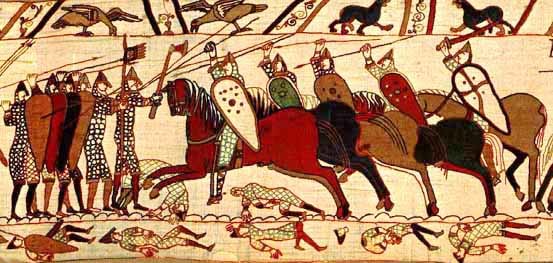
Ugh. Shoulda worn armor. Wikipedia.


Next up, basic combat mechanics.

Thursday, January 1, 2015

Ancients: Turn Sequence (again)

I've been thinking a bit more about the turn sequence for my Ancients game.

All wargame rules are a kind of illusion, suggesting as much as simulating the world the represent.  For this Ancients game, I want to suggest the tidal forces of massed infantry crashing across the field of battle, of simultaneous motion and action of each side, punctuated by sudden, decisive moments when cavalry charges or lines break.

As I indicated in my last post, I think there should be a certain predictability in the turn sequence and flow of the game.  Some games (like, say Malifaux or Bolt Action) randomize and alternate the turn order.  The result seems to me to isolate the different units from mutual support, since you can never entirely predict in which order units will move or shoot, or whether one unit will have an opportunity to act before another.  These systems reflect the unpredictability of skirmish combat and the fog of war.  But they also creates a battlefield in which tiny changes in luck propagate into massive, unpredictable results. 

Imagine a Bolt Action or Malifaux game in which you, as a player want to advance a line of three infantry  units for mutual support.  Whichever one moves first will be out on its own if the other player moves.  It could be charged in the flank before its companion units advance to cover it.  If the other player got to make several moves before you did, your advancing unit could be isolated and overwhelmed.  This doesn't seem like something that would happen in an actual ancient's battle, in which units near each other could presumably match pace fairly easily, and not allow each other to become isolated.

On the other hand, I'm also dissatisfied with the "Warhammer/FoW" I-Go/U-Go sequence in which a player's entire army moves through move, shoot, and melee phases.  The opposing player does not make many meaningful choices when it's not his turn, and mostly just rolls saves.  I think it's a little too predictable, and removes the illusion of simultanity.

So, I'm thinking the best compromise may be something like this:

1) Movement Phase:  Players A and B alternate moving groups of units.  Units that would naturally move together may be moved simultaneously.  So a line of infantry units and all its support units would move together, maintaining a coherent frontage.  The unpredictability would largely effect units operating separately: a cavalry unit working around the flank, a skirmish unit moving in the woods, those heavy huscarls waiting to countercharge, etc. 

Charges would be integrated into the Movement phase.  If a unit can reach its enemy, it is deemed to have charged.  There could be some out-of-sequence reactions, such as fleeing or counter-charging here.  Any such reaction would "use up" the unit's Movement for the turn.

2) Shooting Phase: Players A and B alternate shooting with their units.  There would be no massed fire from units near each other, preserving the illusion that both sides are raining arrows on each other at the same time.  Units which charged in the Movement phase remain valid targets for fire, even if they are in base contact with an enemy.  Certain units which fled may still shoot, if they are sneaky like that.

3) Melee Phase: Melees are resolved for units in base-to-base combat, with players A and B alternating in nominating a melee to resolve.

Different general abilities might modify the usual sequence: for example, an ability might allow a general to move two units before his opponent can react.

I toyed around with different sequences, for example with shooting before moving, but I think this traditional framework remains the most satisfying. 

Sunday, December 14, 2014

How Many Sides?

Onward with designing an ancients game-system!

Let's start with some big decisions.

What scale? 

Ancients games suffer a conundrum -- unlike most modern games which you can play on a 1:1 scale if you want, there are usually more men on an ancient battlefield than any sane person would want to paint.  If you go for a really small scale, you get a more realistic proportion.  If you go for a large one, like 28mm, then you have a more colorful but rather thin-looking battle line.  In either case, each stand or figure will probably represent more than one actual soldier.

I think I will design for 28mm, which is big, colorful and fun to paint.  But, honestly, all that really matters for the game is the footprint of the unit on the table.

Fancy Random Number Generators?

Next up, what kind of dice (or cards or scapulae or spinners or whatever) do I want to use?  Personally, I think there's no reason to use anything other than standard 6-sided dice. Everybody has a metric crap ton of six-siders, which are cheap and easily available.  I find that not much is gained by using a larger die type, like a d10.  If I want more than 6 possible results, it's a lot easier to roll 6-siders twice, in various combinations, than to fiddle with the number of sides.

Plus, psychologically, there is something that's really nice about rolling a handful of dice.

6-siders, it is, then.

I Go/U Go, or Something Fancier?

Most older games are I Go/U Go systems, in which players move and fight with their whole force before ceding the initiative to their opponent.  Many newer games have an alternating system of activation, where one player chooses a unit to move or shoot, and then the other player may do so instead.

The advantage of I Go/U Go is its stately consistency. Players can predict movement across the field and plan reactions in advance, without worrying about actions taking place out of order, or a unit being stuck out of action by a quirk of the activation rules.

The advantage of alternating activations lies in the chaos and simultaneity it brings to the battle.  In the fog of war, you can never really tell where units will be and who will get the jump on whom.

In balance, for an ancients game, I think I prefer the predictability of some variation of the classic I Go/U Go.  In a modern combat game, it is much easier to imagine small units surprising each other and stealing movement on their opponent, than in some huge battle where ranks of men march across an open field.  I think in an ancient battle, you probably could tell in advance where most units would be marching, and plan for it.

Ancient battle relied on the steadiness of battle-lines and of mutual support.  In a alternating system, it's really hard to keep your little dudes lined up, and very easy for a unit to be caught out by itself.

So I intend to use some type of turn system in which players can keep their forces together and in which movement sequence is relatively predictable, although I may introduce some variation to a strict I Go/U Go.  For example, I might allow both players to alternate all their movement, then all their shooting, then all their melee resolution.