


Tuesday, January 28, 2014
Slight Update
I have slightly updated the Martian Colonists to Version 3. I increased the AT of AT Rifles, AT Rockets Launchers, and Howitzers.

Monday, January 27, 2014
Introducing the Martian Colonists
Introduction
The second book for my game is Force Book for the Martian Colonists.

You can download it by clicking on the picture.
Who are the Martian Colonists?
The Martian Colonists are the descendants of humans from Earth. In 1878 Belgian explorers discovered a gate to another world in the Congo region. The great powers of the world created colonies across the newly discovered world scientists christened "Nova Planetia," but which the press inaccurately and popularly called "Mars." Their settlements soon spread across the canals and ruins of the Great Basin region and fended off the primitive native tribes of humans and Brutes.
Then in 1914 disaster struck. The Ancients and their war-machines swept south across the region, destroying cities, slaying populations, and taking slaves. Then, aburptly, they stopped. The outlying human colonies survived, cut off from Earth.
For a decade the colonists have planned their counter-attack. They have developed new vehicles, powerful guns, and advanced tactics to seize the basin again. Now, in 1942, their divisions are trained and ready to fight. The long-planned offensive will begin.
How it Works
Like other armies in this game, the Colonists are meant to use existing model ranges. The Colonists are based on historical inter-war and World War II forces. A typical army at the platoon-level will consist of less than fifty infantry models and a few vehicles. So if you have a 28mm World War I or World War II army, you have a Martian Colonist army too, and you can play this game.
Give it a try!
Quality
The troops available to the Colonial armies vary considerably. Most receive adequate training, destined for service in the coming Offensive. Those seasoned in combat, even small skirmishes gain a valuable edge of experience. A select few are trained, selected and equipped to the highest standard. The Colonial population is low, and must supplement its regular forces with a reserve of civilians trained part-time for police, garrison or other secondary duties.
Doctrines
Even forces with the same equipment may be trained differently. In this game, differences in training and capacity are reflected in special abilities called Doctrines. Activated with a roll, each Doctrines allows your army to do something special. You can choose among different Doctrines before play:
The Martian Colonists are only the first of several forces for the game. In coming months, I will release supplements for other armies too: the hardy non-human Brutes, the proud but hidden Free Cities, and the dastardly, sadistic Ancients who have laid all Mars waste with their endless wars!
The pictures on this page are of Old Glory's British World War One range.
The second book for my game is Force Book for the Martian Colonists.
You can download it by clicking on the picture.
Who are the Martian Colonists?
 |
| A Colonial Officer |

The Martian Colonists are the descendants of humans from Earth. In 1878 Belgian explorers discovered a gate to another world in the Congo region. The great powers of the world created colonies across the newly discovered world scientists christened "Nova Planetia," but which the press inaccurately and popularly called "Mars." Their settlements soon spread across the canals and ruins of the Great Basin region and fended off the primitive native tribes of humans and Brutes.
Then in 1914 disaster struck. The Ancients and their war-machines swept south across the region, destroying cities, slaying populations, and taking slaves. Then, aburptly, they stopped. The outlying human colonies survived, cut off from Earth.
For a decade the colonists have planned their counter-attack. They have developed new vehicles, powerful guns, and advanced tactics to seize the basin again. Now, in 1942, their divisions are trained and ready to fight. The long-planned offensive will begin.
How it Works
Like other armies in this game, the Colonists are meant to use existing model ranges. The Colonists are based on historical inter-war and World War II forces. A typical army at the platoon-level will consist of less than fifty infantry models and a few vehicles. So if you have a 28mm World War I or World War II army, you have a Martian Colonist army too, and you can play this game.
Give it a try!
Quality
The troops available to the Colonial armies vary considerably. Most receive adequate training, destined for service in the coming Offensive. Those seasoned in combat, even small skirmishes gain a valuable edge of experience. A select few are trained, selected and equipped to the highest standard. The Colonial population is low, and must supplement its regular forces with a reserve of civilians trained part-time for police, garrison or other secondary duties.
- Reserve Units are trained and equipped for secondary duties, and are often composed of older men who have only recently been recalled from civilian life. Their last training may have taken place months or years ago. Reserve Units are usually last in line for new equipment. Despite this, Reserve Units are often highly patriotic and committed to current offensive.
- Regular Units have received substantial training. They are usually young men who have volunteered or are serving their mandatory terms of service. The Colonies have tasked their current regular Units with the coming offensive, and many have received new batches of the latest equipment.
- Veteran Units have seen combat and survived. This experience gives them a substantial edge. Most Veteran Units consist of men who have served more than one term of service and intend to make the military their career. Most Veterans have fought Brutes, Native humans, or rebels. Very few have tested themselves against the soldiers of the Free Cities or the Ancients. Most Veteran units are designated for the coming offensive, and have been receiving new equipment and resupply. A few Veteran units, however, are posted in garrisons far from the center of the Colonies and may be making due with older equipment.
- Elite Units consist of only the fittest and ablest of volunteers, and are highly-motivated. They are able close-quarter and melee combatants. The Elite Units are well-equipped. However, many Elite Units are light infantry and thus eschew heavy equipment.
Doctrines
Even forces with the same equipment may be trained differently. In this game, differences in training and capacity are reflected in special abilities called Doctrines. Activated with a roll, each Doctrines allows your army to do something special. You can choose among different Doctrines before play:
- The Armored Doctrine focuses on vehicles, allowing your vehicles to fight more effectively at close and long range, and to move in and out of cover.
- The Assault Doctrine focuses on close combat, letting your troops re-roll close combat attacks and avoid being suppressed by enemy fire.
- The Brutality Doctrine is for forces driven into battle by heartless taskmasters. You can kill your own troops in exchange for benefits in battle. Alles klar, Herr Komissar?
- The Élan Doctrine allows your troops to recover from suppression more quickly and to move faster across the battlefield.
- The Drill Doctrine reflects disciplined troops and their greater volume and accuracy of fire.
- The Professionalism Doctrine reflects the high degree of training in your force, and grants situational bonuses of your choosing.
- The Rugged Doctrine makes your troops tougher, better able to cross difficult terrain and survive punishing enemy fire.
- The Stealth Doctrine lets your force ambush the enemy and conceal themselves in the open.
The Martian Colonists are only the first of several forces for the game. In coming months, I will release supplements for other armies too: the hardy non-human Brutes, the proud but hidden Free Cities, and the dastardly, sadistic Ancients who have laid all Mars waste with their endless wars!
 |
| Martian Colonist squad. |
Sunday, January 19, 2014
Introducing the Core Rules
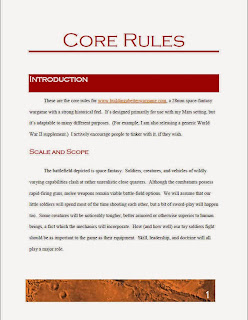 |
| Click on me for the rules. |
Over Christmas break, I revised my core rules into a PDF. Let's take a moment to look at the game, and what it's about.
What's Different about This Game?
My game is a platoon-level space fantasy game. It has two major strengths:
- It can represent a variety of different sci-fi or space-fantasy troops.
- It models fire and movement and suppression in a (mostly) realistic way.
Armor, Monsters, and Vehicles
 |
| This Brute is Tough. |
- Armor: The model is covered in some sort of plating that absorbs or deflects projectiles.
- Toughness: The model is a bigger, tougher creature than normal.
- Vehicle Armor: The model is a vehicle, and has significant armored plating that's heavier than personal armor.
- Cover: The model is behind (or carries with it) terrain or a field that prevents its injury.
- Armor Piercing: Counters armor.
- Massive: Blows up big monsters.
- Anti-Tank: Shoots up vehicles.
- High Explosive: Counters the effect of cover.
 |
| These Colonists escort a Vehicle. |
The game's combat and damage are divided into several phases:
- Shooting: This represents long-ranged shooting. It might kill some enemy, but that's not its main purpose. The Shooting phase is when your models Suppress the enemy in preparation for an assault.
- Assault Fire: Your models have now closed with the enemy, and exchange fire at close range.
- Melee: Your models run up and hit the crap out of things with a chainsaw, bayonet, or pointy stick.
What about Vehicles?
As a platoon-level game, there's room for only a few vehicles on the table. They are a combination of awesome and fragile: with machine-guns aplenty and mostly invulnerable to infantry weapons in the Shooting Phase. But up close, in the Assault Fire or Melee phase, lucky rolls can hit them pretty reliably, meaning any such beast requires an escort of friendly infantry model.
Tuesday, December 31, 2013
New Year's, New Documents
It's a new year, and I'm proud to present major changes to the site. I have rewritten and presented the Core Rules as a PDF (click on the picture).
I have also made my first Force Book, describing the Martian Colonists (click on the picture).

The Martian Colonists v2
Over the next few weeks and months, I will be writing and adding Force
Books for the Free Martians, the Brutes, and the Ancients. These are all working documents. I'd welcome any comments you might be kind enough to forward.
Friday, December 20, 2013
Yule Time
When Odin rides across the sky with a bunch of dead people! For real!
 The time around the Solstice is the time when the days are shortest, the world is dark, and getting through the winter is on everyone's mind. It's also the time when the days start to lengthen again, giving rise to thoughts of rebirth.
So naturally, people stuck in the dark, with little else to do, tend to have a big winter party: Yule, Christmas, Saturnalia, etc.
They also tend to think about death a lot. Christmas time has a lot of creepy stories associated with it, and one of my favorites is the Wild Hunt. During this liminal season, between life and death, when everything is cold, processions of the dead were believed to ride through Northern Europe.
So when Santa rides across the sky, with his eight tiny reindeer, just remember: it could be a lot worse.
 The time around the Solstice is the time when the days are shortest, the world is dark, and getting through the winter is on everyone's mind. It's also the time when the days start to lengthen again, giving rise to thoughts of rebirth.
 So naturally, people stuck in the dark, with little else to do, tend to have a big winter party: Yule, Christmas, Saturnalia, etc.
They also tend to think about death a lot. Christmas time has a lot of creepy stories associated with it, and one of my favorites is the Wild Hunt. During this liminal season, between life and death, when everything is cold, processions of the dead were believed to ride through Northern Europe.
So when Santa rides across the sky, with his eight tiny reindeer, just remember: it could be a lot worse.
Wednesday, December 11, 2013
How to Design a Comp System for 40k?
The Warhammer 40k world is reacting to the release of Escalation. Warhammer 40k continues to be the train-wreck from which I can't look away, or maybe the abusive spouse I can't bring myself to leave.
This column was inspired by a post by Goatboat over at Bell of Lost Souls. He asks whether it is possible to create a tournament system by "broad changes instead of just small 'faq's' to fix specific unit rules". He then gives some suggestions.
More or less, he's asking for a kind of soft comp system. For those who don't know, a comp or "composition" system judges tournament players' army lists. It either gives them a score that helps rate their final place in the tournament or outright forbids certain combinations or units. Various ones have been tried -- I encountered my first ones back in 3rd edition Rogue Trader tournaments -- but GW has abandoned them, and they have fallen out of favor for most players.
I have written about 40k balance issues before here and here. My conclusion has been that 40k's woes result from several problems combining together: some unit are under-priced, some rules are too powerful, and armies can be abusively min-maxed in several different ways. Any real fix would need to originate with GW and would require a rewrite of all the Codices and changes to the core rules.
But in the interest of amateur game design, I will try to design a fix that meets Goatboy's criteria: one that is universally-applicable to all existing armies, that changes few or no core mechanics, and does not mess with the sealed box of existing Codices' unit descriptions or point values.
Most 40k abuses involve maximizing specialist units beyond the capacity of a "normal" army's ability to counter them. So most of my fixes will concentrate on reducing the number of specialized units an army can take. Largely this means strictly limiting the Force Organization Chart.
1) Let's start with Goatboy's suggestion that there be only one Force Org. I like this one. So overall, there will be a limit of 1-2 HQ, 2-6 Troops, 0-3 Elites, 0-3 Heavies, 0-3 Fast Attack, and 1 Fortification. Any allies must come out of this allotment too.
2) Limit all Non-Troop units to 0-2 of any particular unit. So you could only have a maximum of 2 Whirlwinds or 2 Wraithlords or 2 units of Sternguard or whatever. Dedicated transports are instead subject to a limit of 0-4 of the same type.
3) Any mandatory Troops who do not purchase a Dedicated Transport must be taken at their maximum size. Any mandatory Troops that do purchase a Dedicated Transport must be taken at the maximum size that will fit in the transport. (As an exception, if the player intends to run an Independent Character with the unit, it must instead be taken at the maximum size that will still allow the Character to fit in the transport with it. The Independent Character chosen must begin the game as part of the chosen unit.)
4) For every 500 points (or fraction thereof) over 1000 points, the player must take another mandatory Troop choice, subject to the rules above.
5) Limit all Fliers or Flying Monstrous Creatures to a total of 0-2 combined.
6) Disallow any Lords of War, any model with a Str D weapon, or a Void Shield.
7) I also like Chumbalaya's suggestion from the comments. As a special Tournament rule, no 2+ Armor or Invulnerable save may ever be rerolled.
The idea here is to prevent maximization of particular capabilities by duplicating units or transports. It prevents minimization of mandatory selections. It particularlly limits Fliers, which require a strong investment in unusual equipment to counter in large numbers than other types of model. Number 7, is pretty much there just to stop Screamstar and/or Jetbike Seer councils.
This is a hardly a fool-proof system. It punishes some armies more than others. But it may at least be less bad than current, unregulated Warhammer 40k. In the absence of competent attention by Games Workshop itself, I think that's the best we can hope for.
This column was inspired by a post by Goatboat over at Bell of Lost Souls. He asks whether it is possible to create a tournament system by "broad changes instead of just small 'faq's' to fix specific unit rules". He then gives some suggestions.
More or less, he's asking for a kind of soft comp system. For those who don't know, a comp or "composition" system judges tournament players' army lists. It either gives them a score that helps rate their final place in the tournament or outright forbids certain combinations or units. Various ones have been tried -- I encountered my first ones back in 3rd edition Rogue Trader tournaments -- but GW has abandoned them, and they have fallen out of favor for most players.
I have written about 40k balance issues before here and here. My conclusion has been that 40k's woes result from several problems combining together: some unit are under-priced, some rules are too powerful, and armies can be abusively min-maxed in several different ways. Any real fix would need to originate with GW and would require a rewrite of all the Codices and changes to the core rules.
But in the interest of amateur game design, I will try to design a fix that meets Goatboy's criteria: one that is universally-applicable to all existing armies, that changes few or no core mechanics, and does not mess with the sealed box of existing Codices' unit descriptions or point values.
Most 40k abuses involve maximizing specialist units beyond the capacity of a "normal" army's ability to counter them. So most of my fixes will concentrate on reducing the number of specialized units an army can take. Largely this means strictly limiting the Force Organization Chart.
1) Let's start with Goatboy's suggestion that there be only one Force Org. I like this one. So overall, there will be a limit of 1-2 HQ, 2-6 Troops, 0-3 Elites, 0-3 Heavies, 0-3 Fast Attack, and 1 Fortification. Any allies must come out of this allotment too.
2) Limit all Non-Troop units to 0-2 of any particular unit. So you could only have a maximum of 2 Whirlwinds or 2 Wraithlords or 2 units of Sternguard or whatever. Dedicated transports are instead subject to a limit of 0-4 of the same type.
3) Any mandatory Troops who do not purchase a Dedicated Transport must be taken at their maximum size. Any mandatory Troops that do purchase a Dedicated Transport must be taken at the maximum size that will fit in the transport. (As an exception, if the player intends to run an Independent Character with the unit, it must instead be taken at the maximum size that will still allow the Character to fit in the transport with it. The Independent Character chosen must begin the game as part of the chosen unit.)
4) For every 500 points (or fraction thereof) over 1000 points, the player must take another mandatory Troop choice, subject to the rules above.
5) Limit all Fliers or Flying Monstrous Creatures to a total of 0-2 combined.
6) Disallow any Lords of War, any model with a Str D weapon, or a Void Shield.
7) I also like Chumbalaya's suggestion from the comments. As a special Tournament rule, no 2+ Armor or Invulnerable save may ever be rerolled.
The idea here is to prevent maximization of particular capabilities by duplicating units or transports. It prevents minimization of mandatory selections. It particularlly limits Fliers, which require a strong investment in unusual equipment to counter in large numbers than other types of model. Number 7, is pretty much there just to stop Screamstar and/or Jetbike Seer councils.
This is a hardly a fool-proof system. It punishes some armies more than others. But it may at least be less bad than current, unregulated Warhammer 40k. In the absence of competent attention by Games Workshop itself, I think that's the best we can hope for.
Sunday, December 8, 2013
Rewriting
I've started revising my core game rules this weekend. My intention is to bring the quality up to the level of a professional print publication, or as nearly as I can manage on my own. Right now, I'm doing it in Word. Eventually, it will become a PDF for the site.
My first pass will be a play test version of the core rules, with only minimal art.
The next step will be a series of army books for each of the four armies I've been developing. I'll start with the Colonists and the Free Martians, which are farthest along.
I also want to create a generic World War II infantry list. This site is largely an adjunct of www.wwpd.net and a lot of readers come here from www.boltaction.net. I'd like to lure some of you readers into trying out my rules with figures you already have.
So, there's not much to show on the blog at the moment, but work continues...
 |
| A Sample Page |
Subscribe to:
Posts
(
Atom
)